Twelve categories of Egyptian food
Below is a summary of what each section of the guide covers, with approximate price ranges in Egyptian pounds as of 2026. Prices are updated seasonally — Egyptian inflation means they shift, and we note when a figure was last verified.
| Category | Key dishes / venues | Typical spend (EGP / person) | Full guide |
|---|---|---|---|
| Koshari | Classic koshari, lentil-rice variant, koshari bil-extra sauce | 30–80 | Regional dishes |
| Ful & ta'ameya breakfast | Ful medames, ta'ameya sandwich, baladi bread, eggs | 25–70 | Street food |
| Grills & kebab | Kofta, kebab, grilled pigeon, liver, mezze spreads | 280–650 | Restaurants |
| Seafood (Alexandria style) | Grilled sea bass, calamari, shrimp tagine, fish stew | 350–900 | Restaurants |
| Molokhia & home dishes | Molokhia with rabbit or chicken, fattah, roz bil-laban | 60–180 | Regional dishes |
| Mahshi | Stuffed vine leaves, peppers, aubergine, courgette | 80–200 | Regional dishes |
| Hawawshi & feteer | Spiced minced meat pastry, feteer meshaltet sweet and savoury | 45–120 | Street food |
| Desserts & patisserie | Konafa, basbousa, om ali, baklava, qatayef | 40–160 | Desserts |
| Ahwa & coffee culture | Turkish coffee, koshary-style tea, shisha, juice bars | 20–80 | Regional dishes |
| Vegetarian | Koshari, ful, molokhia (veg), mahshi, bean dishes | 25–180 | Vegetarian |
| Fine dining Egyptian | Modern Egyptian tasting menus, heritage recipe restaurants | 700–1800 | Restaurants |
| Guided food tours | Walking tours, neighbourhood routes, private groups | 750–2800 | Food tours |
Koshari — Egypt's national dish
Koshari is Egypt's great democratic food: a layered bowl of rice, brown lentils, macaroni and chickpeas, topped with a vinegared tomato sauce, crispy fried onions and a splash of garlic-vinegar or chilli oil to taste. It is the food of bus drivers, university students, government clerks and tourists who wandered off the prescribed route. Served from dedicated counters that often do nothing else, costing between 35 and 75 EGP depending on size and neighbourhood in 2026, it is fast, filling, resolutely plant-based, and one of the most satisfying street meals we know of anywhere in the world.
The best koshari counters in Cairo have been doing this for decades. The rhythm is practised to the point of choreography: the server assembles the bowl in seconds, asks how much sauce, passes it across the counter before you've finished paying. Each component has been cooked separately and sits in its own container. Freshness of the tomato sauce and the heat of the crispy onions are the two variables that most clearly separate an excellent bowl from a mediocre one. We have strong opinions about both, and we name the counters we keep going back to — in Downtown, in Heliopolis, in Mohandessin, in Maadi.
There are variations worth knowing: some shops serve it dry (with less sauce), some add fried aubergine on top, some use a slightly different pasta shape. The lentil-to-rice ratio varies between cooks and has its partisans. Our regional dishes guide explains the variations and gives you the vocabulary to order exactly what you want at the counter.
Ful & ta'ameya — the Egyptian breakfast
The morning of Cairo is ful and ta'ameya. Ful medames — dried fava beans slow-stewed overnight, dressed in the morning with lemon juice, cumin, olive oil and garlic — is one of the oldest continuously eaten dishes in the world. The evidence for fava beans as a staple food in Egypt goes back to pharaonic times. The modern version, scooped from a great copper pot into a bowl or folded inside a fresh baladi loaf, remains unchanged in any essential respect from what it has been for centuries. It is eaten at home, at street carts, in simple cafeterias, in fancy breakfast restaurants. It is democratic, cheap (a generous portion with bread runs 30–60 EGP in 2026) and deeply satisfying.
Ta'ameya is the Egyptian version of falafel, made with fava beans rather than chickpeas, which gives it a distinctly earthier, greener character than the Middle Eastern versions better known in the West. Mixed with fresh coriander and dill, then fried hot in oil until the outside crisps and the inside remains tender and bright green, it is one of those foods that seems simple until you eat a bad version of it and realise how much technique it requires. The best ta'ameya in Cairo comes from carts and small shops that have been refining the same recipe for a generation. We cover them neighbourhood by neighbourhood on the street food guide.
The proper Egyptian breakfast also includes a fried or boiled egg, a small salad of tomato and cucumber, some white cheese (gibna beyda), and always a stack of fresh baladi bread — the round, slightly charred flatbread baked in communal ovens throughout the city. Ordering a full breakfast spread for two at a good ful café in Cairo will rarely cost more than 150–200 EGP and will keep you going until mid-afternoon. It is, without qualification, one of the finest breakfasts on earth.
Grills, kebab and the Egyptian restaurant table
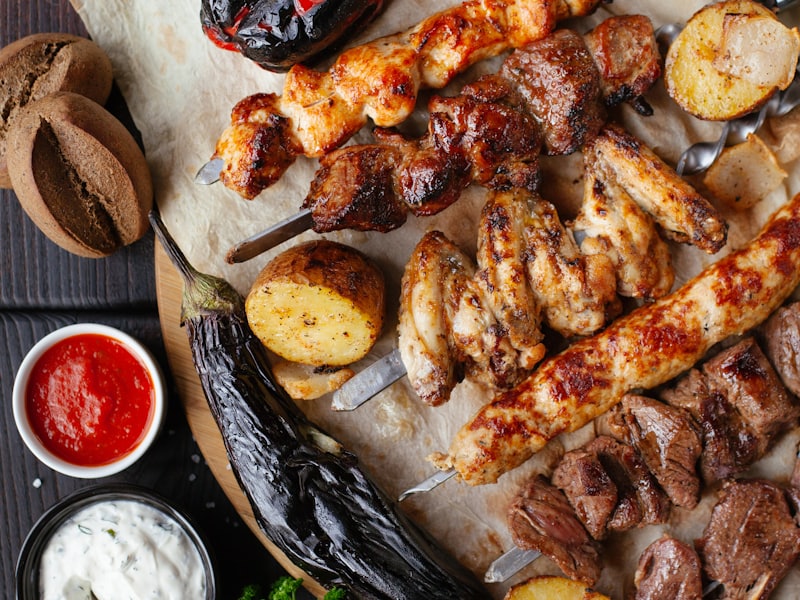
The sit-down Egyptian restaurant, at its most essential, is a grill restaurant. A table of mezze arrives first: tahini, baba ghanoush, torshi (pickles), bread, a fattoush or plain tomato salad. Then comes the grill — kofta (spiced ground meat shaped around skewers), kebab (chunks of marinated lamb or beef), grilled chicken, and possibly grilled pigeon (hamam), which is a delicacy particularly associated with the areas around the Giza plateau and Upper Egypt. Grilled liver — liver and kidney, cooked quickly over a high flame and served in a roll — is a street-food variant found at particular carts rather than restaurants.
The great grill restaurants of Cairo are institutions in the full sense: places that have been in the same location, under the same family, with broadly the same menu, for forty or fifty years. They are not the cheapest option — a proper mixed grill for two with mezze and drinks at an established restaurant will cost 600–900 EGP in 2026 — but they represent a particular Egyptian style of hospitality and abundance. The table fills up, the bread keeps coming, and leaving hungry is close to impossible. We profile the best in our restaurant guide, with notes on which are genuinely worth the trip from across Cairo.
A category apart is the modern Egyptian restaurant: a newer wave of places, often in Zamalek, Maadi and the New Cairo suburbs, taking traditional Egyptian flavours and presenting them in a more contemporary dining format. These range from very good to very pretentious. We assess them on whether the food itself justifies the price, irrespective of the surroundings.
Alexandria-style seafood in Cairo
Egypt has a long coastline on both the Mediterranean and the Red Sea, and Cairo's proximity to Alexandria — two hours by train — means the city has always had access to fresh Mediterranean fish. There is a style of seafood restaurant in Cairo, particularly in the older parts of the city and in the Dokki and Agouza neighbourhoods, that is directly descended from the Alexandrian fish restaurant: fresh fish displayed on ice at the entrance, chosen by the customer, sold by weight, then grilled or fried to order. A typical spread might include grilled sea bass (qarous) or bream (denys), a calamari dish, shrimp in tomato sauce, a garlic dip and bread.
These restaurants operate on a different logic from tourist-facing establishments. The prices are posted by the kilo, not per dish, and the fish is as fresh as the supply chain allows — which in the good places is very fresh indeed. A generous seafood meal for two, with accompaniments, runs 500–900 EGP in 2026 at a reliable mid-range spot. We give specific recommendations and notes on how to read the menu (and negotiate the weight) in the restaurant guide.
For those who want to experience Alexandrian seafood in its original setting, the drive or train to Alexandria is worth doing. We note the best spots there too, and our private food tour option includes a customised Alexandria day trip for groups who want to see both cities.
Molokhia, fattah and home-style Egyptian cooking
The food that Egyptians eat at home — and that home-cooking restaurants try to replicate — is a distinct category from street food and restaurant food, and it is central to understanding what Egyptian cuisine actually is. Molokhia is the first dish to know: a dark-green soup or stew made from finely chopped Corchorus leaves (jute), cooked with garlic and coriander and served with chicken or rabbit. The texture is gelatinous, almost sticky, and the flavour is rich and slightly pungent. It is one of those dishes that divides opinion among newcomers but that Egyptians are almost universally devoted to. We explain the regional variations — Upper Egyptian molokhia is drier and more intensely flavoured; the Delta version is soupier — and give honest notes on which Cairo restaurants do it best.
Fattah is the great celebratory dish: layers of dried and toasted bread soaked in meat broth, topped with rice, then meat (usually lamb or beef), finished with a tomato-vinegar sauce and a scattering of fried onions and garlic. It is a dish of special occasions — Eid, weddings, births — and its preparation is a household event. Finding it well-made in a restaurant is harder than it sounds. We know where to go. See the full write-up in regional dishes.
Roz bil-laban — rice cooked slowly in milk with rose water and a scattering of raisins, served warm or chilled — is the Egyptian rice pudding, and it is among the most comforting things the cuisine has to offer. The best versions are found not in restaurants but in dedicated pudding shops (halawani) and at certain patisseries. Our desserts guide covers the full landscape of Egyptian sweet eating.
Mahshi — the stuffed vegetable family
Mahshi refers to the whole family of stuffed vegetables: courgettes (kosa), aubergine (betingan), peppers, vine leaves, tomatoes, onions and cabbage leaves, all filled with a mixture of rice, tomato, herbs and spices, then slow-cooked until everything has absorbed the flavour of the broth. It is a labour-intensive, time-consuming category of cooking — the stuffing and rolling of vine leaves alone is an hour's careful work — which is why it is fundamentally home cooking rather than restaurant food. When you find it well-made in a restaurant, the kitchen cares.
The rice filling varies: some versions are herby (fresh coriander, dill, parsley), some include minced meat, some are purely vegetarian. The vine leaf version — wara' einab — is the most delicate, rolled tightly and served in a pile with lemon. The courgette version — kosa mahshi — hollowed with a small tool and stuffed densely, is the most substantial. At their best, these are extraordinary things: the vegetable itself has absorbed the spiced rice and broth, the textures are complex, and the whole dish tastes like it has been cooking since morning — because, usually, it has.
We cover mahshi in detail in the regional dishes guide and flag the handful of Cairo restaurants where it is made with real care, plus the seasons when you're most likely to find it (it is an autumn and winter dish in its most elaborate forms, though courgette mahshi appears year-round). The vegetarian section notes which mahshi versions are meat-free and how to confirm this when ordering.
Hawawshi, feteer and pastry counter culture
Hawawshi is the Egyptian meat pastry: spiced minced beef or lamb, mixed with chopped onion and sometimes fresh chilli, packed into a baladi bread pocket and baked in a very hot oven until the outside crisps and the fat from the meat has soaked through the bread. The result is somewhere between a meat pie and a stuffed flatbread, and it is one of the great Cairo street foods. It is particularly associated with the working-class neighbourhoods of Old Cairo, Abbassiya and Shubra, where the best practitioners operate. A good hawawshi costs 60–90 EGP in 2026. A bad one is immediately obvious. Sherif Adel has mapped the best on the street food guide.
Feteer meshaltet is a different beast entirely: a layered, flaky dough made by folding butter or clarified butter into the pastry repeatedly, similar to a rough puff pastry but with its own Egyptian character. It can be sweet (filled with honey and cream, or jam) or savoury (with cheese, minced meat or egg), or served plain as a vehicle for what you put on top. The best feteer makers have a particular technique for stretching and layering the dough that produces an almost lace-like texture in the cooked pastry. We cover both in the street food section, with specific shops and price notes.
Desserts and the patisserie tradition
Egyptian desserts cover a spectrum from ancient to modern, from street counter to white-tablecloth patisserie. Konafa — shredded wheat pastry layered over white cheese or nuts, soaked in syrup — is the most celebrated, particularly during Ramadan, when patisseries across Cairo fill with people buying whole trays of it. Basbousa is a semolina cake soaked in syrup and cut into diamonds; om ali is a bread pudding layered with cream, nuts and raisins and baked until bubbling — the Egyptian version of a bread-and-butter pudding, richer and less restrained. Baklava in the Egyptian style tends toward a lighter syrup and more nut filling than the Turkish or Lebanese versions.
Qatayef — small pancakes filled with cream or nut paste and folded in half, then either deep-fried or eaten fresh — appear during Ramadan and Eid and are among the most seasonal treats in the Egyptian calendar. Roz bil-laban (rice pudding with rose water and raisins) and muhallabia (a milk and rose-water blancmange) are available year-round at halawani (pudding shops), which occupy their own category in the city's food landscape. These are not restaurants and not bakeries; they are dedicated to a handful of cold sweets, usually refrigerated, usually very cheap.
The full desserts guide covers all of the above in detail: where to find the best konafa in Cairo (a subject of significant local pride), which patisseries are worth a trip, the seasonal calendar of Egyptian sweets, and the difference between a neighbourhood halawani and a polished patisserie selling the same things at three times the price.
Ahwa — the Egyptian coffee house
The ahwa is the Egyptian coffee house, and it is one of the great institutions of urban life in the Arab world. At its most basic it is a collection of small tables and chairs, often on a pavement or in a covered alley, serving Turkish coffee, tea, karkadeh (hibiscus drink), and in many cases allowing customers to smoke shisha (waterpipe). It is a place primarily for men in the traditional form, though this varies by neighbourhood and has been changing, particularly in Zamalek, Maadi, and the university districts. The ahwa functions as a social club, a place to play backgammon, watch football on a screen propped in the corner, and spend an afternoon on a single cup of coffee without anyone suggesting you leave.
Turkish coffee in Egypt (qahwa turki) is served very strong, unfiltered and unsweetened unless you specify — you order it mazbouta (medium sweet), ziyada (extra sweet), or sada (plain). The grounds settle to the bottom of the small cup and are not drunk. Tea is black and usually very sweet. The juice bars that operate alongside or in place of the traditional ahwa — serving fresh guava, mango, sugarcane (asab) and mixed fruit juices — are a Cairo summer essential. Sugarcane juice pressed fresh at a street cart, served cold over ice for around 20–30 EGP, is one of the city's great simple pleasures.
We cover ahwa culture and the best neighbourhood coffee houses in the context of the dining etiquette guide, which explains the unwritten rules of the ahwa table and what to order when you arrive not knowing what to ask for.
Vegetarian and plant-based Cairo
Egypt is, to an extent that often surprises visitors, a naturally vegetarian-friendly food culture. This is not a modern affectation. The Egyptian everyday diet has always been heavily plant-based: beans (fava and lentil), grains (rice, bread), vegetables (molokhia, okra, aubergine, courgette, peppers) and spices form the backbone of the cuisine. Meat is eaten, but it is often a flavouring rather than the centrepiece — particularly in home cooking and working-class street food. The coptic Christian tradition of fasting periods — when meat, dairy and eggs are avoided — has also generated an extensive tradition of naturally vegan cooking that is woven into the cuisine without anyone having labelled it as such.
Practically: a vegetarian in Cairo can eat extremely well. Koshari is vegan by default. Ful and ta'ameya are vegan by default. Mahshi can be made without meat (ask for it bil-roz fakaat — rice only). Molokhia can be cooked in vegetable broth (check before ordering). Bean soups, lentil dishes, roasted vegetables, cheese pastries and stuffed flatbreads — the list of what is available without any adaptation is long. The vegetarian guide covers all of this: what is naturally plant-based, what to check before ordering, and which Cairo restaurants have made a genuine commitment to vegetarian and vegan options beyond an afterthought salad.
Fine dining and modern Egyptian
A small but genuinely interesting wave of restaurants in Cairo has, over the past decade, been treating Egyptian culinary heritage as something worth presenting in a fine-dining context. This means different things in different places: some are formal tasting-menu restaurants where a chef trained in Europe applies technique to Egyptian ingredients — Delta rice, Upper Egyptian honey, Sinai za'atar, Red Sea fish — in a setting designed for occasion dining. Others are more casual but equally serious: neighbourhood places committed to using heritage recipes and regional produce, sourcing their molokhia leaves from specific Delta farms, their lamb from specific Upper Egypt suppliers, their bread from a particular baker they have worked with for years.
The best of these restaurants are doing something genuinely worthwhile: creating a context in which Egyptian food is treated with the same seriousness that French or Japanese cooking commands internationally. The least impressive are charging Mayfair prices for food that is ordinary in everything except its presentation. We assess both categories honestly in the restaurant guide, noting which fine-dining establishments justify the spend and which are trading primarily on décor.
Pricing at the top end: tasting menus at the most formal Egyptian restaurants in Cairo run 1,200–1,800 EGP per person before drinks, which is expensive by Cairo standards but modest by international fine-dining comparison. For a group wanting a single special-occasion meal in Cairo, we provide personalised recommendations based on size, budget and what kind of Egyptian food you want to be the centrepiece.
Guided food tours — eating in context
The guided food tour is the most immersive way to understand a food culture that you've never encountered before. Walking through a neighbourhood with someone who knows it — who knows which stall has been making the best koshari in the district for thirty-five years, which ahwa was frequented by particular writers and musicians, why this corner smells of fresh bread at five in the morning and not at noon — compresses weeks of exploration into an evening.
Cairo Table's food tours are designed by Adham Lotfy and led by members of the Cairo Table team. We offer three formats: a self-guided map and guide pack for independent explorers (the "Self-Guided Map"), a small-group evening food walk through Downtown Cairo or Zamalek (the "Evening Food Tour"), and a private or custom tour for groups wanting a bespoke itinerary, specific dietary requirements or an Alexandria day-trip component.
All tour food is included in the price. We don't take groups to places we haven't visited independently multiple times and wouldn't eat at on our own. The full breakdown of formats, pricing and what's included is on the food tours pricing page. To book or ask a question about any tour, reach the team directly — group sizes are small and availability is limited.
Start with the guide that fits your trip
Whether you're arriving in a week or already in Cairo looking for dinner tonight, there's a section of the guide that answers the question you have right now.